

How To Draw A Pert Chart
What Is a PERT Chart?
A PERT chart is a visual project management tool used to map out and track the tasks and timelines. The proper noun PERT is an acronym for Project (or Programme) Evaluation and Review Technique.
How Is a PERT Chart Different from a Gantt Chart?
PERT charts are similar to Gantt charts in that they offer a graphical view of a project's tasks, schedule, and timelines. But at that place are several pregnant differences between these two types of project management diagrams:
1. Gantt charts are bar graphs; PERT charts are gratis-course
Gantt charts are drawn as bar graphs forth a timeline, as shown below. They represent the tasks and phases of a project with horizontal bars, each drawn to a length representing its estimated timeframe.
A PERT nautical chart, by dissimilarity, can be drawn as a free-form diagram. Project managers create PERT charts by drawing boxes or circles ("nodes") representing events or milestones and connecting them via arrows, representing the tasks that must be completed between each milestone and the amount of time the team volition have to consummate each task.
2. PERT charts illustrate dependencies; Gantt charts do not
One disadvantage of using a Gantt chart to track a projection is that it does not indicate chore dependencies. Each bar on the graph stands alone. This makes it hard for project managers to know how much ane missed deadline could affect other chart tasks.
PERT charts solve this challenge with the employ of directional arrows. These directional (or "concurrent") arrows indicate that a series of tasks must be completed in sequence because they accept interdependencies. On the other manus, diverging arrows indicate functions that tin can be completed parallel or out of order considering they do not have dependencies.
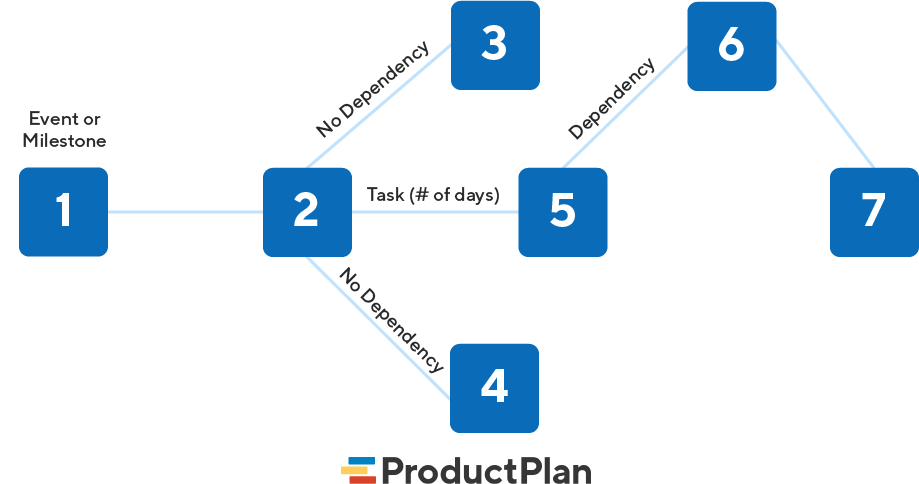
In the PERT chart example beneath, you can see the chore represented in node 1 has a dependency because its arrow goes only to node two. From node 2, however, the team may work on either or both of the tasks represented by the diverging arrows going to nodes iii and 4. Therefore, these activities practice not take dependencies.

What Should a PERT Chart Template Include?
To explain the components of a typical PERT nautical chart, allow's apply this mockup of a hypothetical marketing team's programme to ringlet out a new campaign.
- Numbered nodes
These are the numbered boxes you see in the PERT chart example above. (Some project managers choose to draw them every bit circles.)
Each node represents an outcome or milestone in the project, completion of one stage, or a series of tasks needed to move the projection forward.
- Directional (or concurrent) arrows
The arrows on a PERT chart correspond the tasks or activities that need to exist completed before the team tin can move on to the adjacent upshot or stage in the projection.
The job between nodes one and 2 ("identify market segment") is a directional or concurrent arrow in the mockup above. This indicates the task must be completed in the sequence indicated. Project managers use directional arrows to schedule activities that have dependencies.
- Divergent arrows
These arrows stand for tasks that a team may work on simultaneously or in whatsoever sequence they choose because they exercise not have dependencies. In the mockup here, you can run across an example of this after node 2, for example. The team may work first on the activities leading to node iii or node 4, or they may choose to complete them simultaneously.
What Are the 4 Steps to Create a PERT Chart?
To create a PERT chart, a project management team should follow these steps.
Step 1: Identify all of the project'south activities.
First, define all of the major phases, milestones, and tasks needed to complete the project.
Pace ii: Place dependencies
If you make up one's mind some tasks or activities accept dependencies, you volition want to draw those tasks with directional arrows. This will ensure your team knows the sequence they need to tackle each task.
Step iii: Draw your chart.
The adjacent step is to take the events and milestones (numbered nodes) you've identified and draw them out. And so write out the tasks and activities that the team must complete betwixt each node, using directional arrows or divergent arrows accordingly.
Footstep 4: Institute timelines for all activities.
You should at present set a timeframe when the squad will need to complete those tasks along with all arrows. For example, in our mockup above, you tin encounter the "Train sales" action has a timeframe of 1 24-hour interval. This can represent the estimated timeframe and/or deadline you set for the activity.
Related Terms
Gantt chart / projection roadmap / timeline roadmap / Kanban board / agile product possessor /
Learn More Ways to Create Strategic Documents for Your Team
Download our Roadmap Template Guide

Source: https://www.productplan.com/glossary/pert-chart/
Posted by: brunineyes.blogspot.com
0 Response to "How To Draw A Pert Chart"
Post a Comment